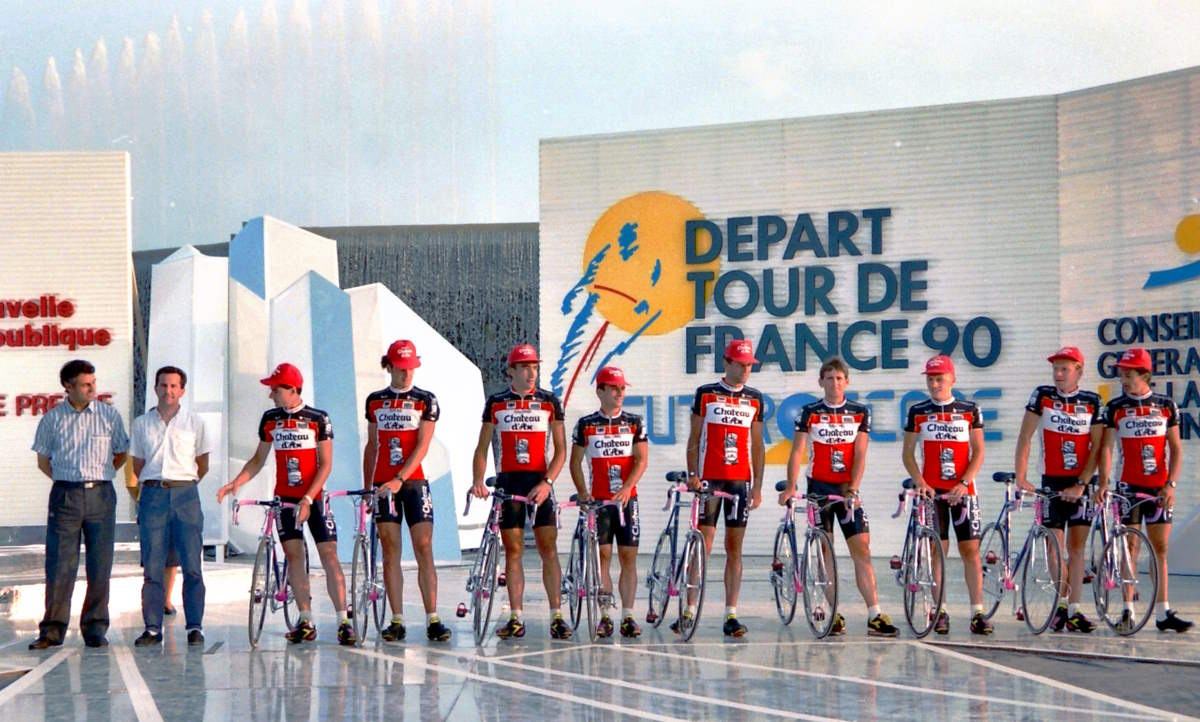
Cycling has always been a sport of evolution and innovation, and the Chateau d’Ax-Salotti team exemplified this spirit during their remarkable 1990 season. This retrospective delves into the highlights of that transformative year, exploring the pivotal races, standout performances, and the enduring legacy of a team that left an indelible mark on the cycling world.
Chateau d’Ax-Salotti Cycling Team
Founded in 1983 as Mareno-Wilier Triestina, the cycling team quickly established itself as a formidable presence in the professional cycling world. In 1988, it officially became Chateau d’Ax-Salotti. Sponsored by the Italian furniture manufacturer Chateau d’Ax, the team was known for its distinctive kits and strong performances. Over the course of a decade, from 1983 to 1993, Chateau d’Ax-Salotti evolved and adapted, showcasing some of the sport’s most memorable moments and riders.
The 1990 season stood out as a transformative period for Chateau d’Ax-Salotti, characterized by strategic victories and the rise of key riders who would leave a lasting mark on the sport. Despite undergoing various sponsorships and name changes, the team consistently maintained its competitive edge, ultimately evolving into Team Polti in 1993. This retrospective delves into the highlights of the 1990 season, examining pivotal races, standout performances, and the enduring legacy of Chateau d’Ax-Salotti.
The 1990 season was a pivotal period for the Chateau d’Ax-Salotti cycling team, characterized by significant achievements, technological advancements, and dynamic evolution in both equipment and team branding. Renowned for their striking pink and dark blue graphics and equipped with Shimano Dura-Ace gruppos, the team continually evolved and improved throughout the season. As the team celebrated these victories, technological advancements also played a crucial role in their success. The introduction of Shimano’s Dual-Control levers and Dual-Pivot brakes in 1990 revolutionized the cycling world, setting new standards for performance and reliability.

Gianni Bugno, the team leader, was a standout performer, clinching victories in several key races. His success was bolstered by the strong camaraderie and teamwork within the Chateau d’Ax-Salotti team. Mauro-Antonio Santaromita, serving as a crucial domestique, provided essential support in the mountains and during pivotal stages, enabling Bugno to maintain his lead and secure overall victories. The team’s strategic adoption of new technology further enhanced their competitive edge.
The Chateau d’Ax-Salotti team was renowned for its strong camaraderie and teamwork. Riders like Santaromita played pivotal roles in ensuring the success of their leaders, often sacrificing their own chances for the benefit of the team. This spirit of cooperation and dedication was a hallmark of the team’s approach, contributing to their numerous successes throughout the season. In addition to their teamwork, the evolution of their bike frames also contributed to their competitive edge.
Key Changes Ahead of the 1990 Cycling Season

The transition from 1989 to 1990 brought in new talents such as Luigi Botteon, Giuseppe Calcaterra, Sergio Finazzi, Roberto Gusmeroli, Mario Kummer, Mauro Antonio Santaromita, Jan Schur, and Mario Scirea. These additions infused fresh energy and skills into the team, enhancing their competitive edge.
Conversely, the team bid farewell to several riders from the 1989 roster, including Giovanni Paolo Bottoia, Claudio Corti, Milan Jurčo, and Alessandro Pozzi. These departures marked the end of an era but also paved the way for new strategies and dynamics within the team.
With the new year and tem came new colors. The striking pink and dark blue graphics of the Chateau d’Ax-Salotti team bikes were more than just eye-catching; they symbolized the bold and innovative spirit of the team. Each frame, meticulously crafted and equipped with cutting-edge technology, represented the pinnacle of cycling performance in 1990.

Legacy and Impact
The Chateau d’Ax-Salotti team’s ability to adapt and innovate exemplified their forward-thinking approach. Their distinctive kit and strong performances left a lasting impression on the cycling world, making them a memorable chapter in the sport’s history during the 1990s. The 1990 season, in particular, stands out for its significant achievements, especially those of its leader Gianni Bugno, and the dynamic evolution of both the team and its equipment.
As the team transitioned into Team Polti in 1993 with Bianchi now supplying the frames, they carried forward the legacy of innovation and excellence established during their years as Chateau d’Ax and Moser frames, first with Salotti and then with Gatorade. The story of Chateau d’Ax-Salotti’s 1990 season is one of resilience, adaptation, and a relentless pursuit of excellence, qualities that have cemented their place in cycling history.
The team’s ability to embrace new technologies and maintain a competitive edge showcased their forward-thinking approach. Their distinctive kit and impressive performances left an indelible mark on the cycling world, cementing the Chateau d’Ax-Salotti team as a memorable chapter in the sport’s history during the 1990s.

Moser Leader SC Team Frames
The Moser Leader SC frame, used by Santaromita during the 1990 Chateau d’Ax season, was crafted from ORIA FSB (Fillet Silver Brazed) tubing, renowned for its stiffness and superior performance compared to other frames of that era. SC stands for “Senza Congiunzioni,” which means “without conjunctions” and refers to frames constructed without traditional joints or lugs.
Unlike most professional peloton bikes, the Moser Leader SC was fillet brazed and featured what was described at the time as an integrated seat tube post design. However, “integrated” isn’t entirely accurate by today’s standards, as a seatpost was still necessary. The seat tube extended beyond the top tube, requiring an expander bolt type seatpost, similar to the quill stems used at the time. This frame, combined with the Shimano Dura-Ace 7402 gruppo, created a top-tier racing machine.
Notably, internal rear brake cabling was omitted on all Moser team bikes, starting with the early Leader SC and continuing with the AX frames. As early as 1986, the Moser Leader SC frames made for consumers were produced with internal rear brake cabling. However, extensive examination of period photos reveals that none of the Chateau d’Ax bikes had this feature. This distinction helps identify frames made for professional racing rather than consumer use.
Benefits of Fillet Brazed and Lugless Frame Construction
Fillet brazing and lugless frame construction offer several benefits:
- Design Flexibility: Without the need for lugs, builders can create custom geometries and use tubes of various shapes and sizes. This allows for more personalized and optimized frame designs.
- Smooth Joints: Fillet brazing creates smooth, seamless joints that are aesthetically pleasing and can be easier to clean. The smooth contours also help distribute stress more evenly across the frame.
- Weight Savings: Lugless frames can be lighter because they don’t have the added weight of lugs. Additionally, the tubes can be butted more aggressively, reducing weight while maintaining strength.
- Structural Integrity: The brazing process is gentler on frame tubes because it avoids heating them to temperatures that could compromise their integrity. This method helps preserve the structural strength of the tubes.
- Custom Tube Choices: Builders can use a wider variety of tube sizes and shapes, which can lead to better performance characteristics tailored to each rider’s needs.
Overall, many cyclists and frame builders value fillet brazing and lugless construction for their blend of visual appeal, reduced weight, and versatile design options.
In 1990, Shimano’s Dura-Ace components were becoming increasingly popular in the professional peloton. While exact numbers are hard to pinpoint, several top teams were known to use Dura-Ace components, especially with the introduction of the innovative Dual-Control STI Levers that year. Shimano’s push to provide high-performance, reliable components made Dura-Ace a preferred choice for many competitive teams.
Moreover, the introduction of Shimano’s innovative Dual-Control shifters and Dual-Pivot brakes further enhanced the team’s performance. The revered Campagnolo now had a strong rival in Shimano, as Dura-Ace components began to set new standards in racing technology.
The addition in the 1990 season of Shimano’s innovative Dura-Ace Dual-Control shifters and Dual-Pivot brakes to the Chateau team’s Moser frame arguably made it one of a select group of bikes in the professional peloton equipped with these cutting-edge components, enhancing its performance, and setting a new standard for racing technology.


Chateau d’Ax-Salotti Cycling Team 1990 Season Highlights
Team Roster and Achievements
The Chateau d’Ax-Salotti team boasted a strong roster, including notable riders like Gianni Bugno and Tony Rominger. These riders contributed significantly to the team’s success in various races, including the Giro d’Italia and the Tour de France.
- Gianni Bugno
- Tony Rominger
- Giovanni Fidanza
- Jan Schur
- Giuseppe Calcaterra
- Alberto Volpi
- Mario Kummer
- Camillo Passera
- Roberto Gusmeroli
- Franco Vona
- Mario Scirea
- Valerio Tebaldi
- Mauro Antonio Santaromita
- Stefano Zanatta
- Ennio Vanotti
- Luigi Botteon
- Ettore Badolato
- Sergio Finazzi
- Roberto Amadio
Gianni Bugno’s Achievements
Gianni Bugno was undoubtedly the star of the Chateau d’Ax team, achieving remarkable success in his cycling career. He won the Giro d’Italia in both 1990 and 1991. His 1990 victory was particularly notable as he led the race from start to finish, a rare and impressive feat. In 1991, he successfully defended his title, further cementing his status as one of the top cyclists of his era. Bugno’s remarkable achievements were complemented by the essential support provided by riders like Mauro-Antonio Santaromita.
Bugno also secured victories in stages 11 and 18 of the Tour de France, showcasing his versatility and endurance. Additionally, he triumphed in prestigious one-day races, winning the Milan-San Remo classic and the Wincanton Classic. There is so much already written about Gianni Bugno that I couldn’t do his achievements justice in this brief write-up. His legacy in the world of cycling remains truly impressive.
Mauro Antonio Santaromita

Mauro Antonio Santaromita, born on September 18, 1964, in Varese, Italy, is a former professional road racing cyclist who had a distinguished career spanning from 1984 to 1997. During his career, Mauro participated in four editions of the Tour de France and ten editions of the Giro d’Italia, showcasing his endurance and skill in some of the most challenging races in the cycling world.
His most notable achievement was winning the overall Giro del Trentino in 1989, a testament to his prowess and dedication to the sport.
Cycling is a significant part of the Santaromita family legacy. Mauro’s brother, Ivan Santaromita, also pursued a career in professional cycling, contributing to the family’s reputation in the sport. The passion for cycling continued with Mauro’s son, Alessandro Santaromita, who followed in his father’s footsteps, aiming to make his mark in professional cycling. The Santaromita family’s dedication to cycling is evident through their achievements and ongoing commitment to the sport, making them a remarkable example of a family deeply rooted in cycling history.
Santaromita’s professional cycling career was marked by his association with several prominent teams and numerous memorable moments. He began his career with Magniflex – Centroscarpa from 1986 to 1987, followed by a stint with Alba Cucine – Benotto – Sidermec in 1988. In 1989, he rode for Pepsi-Cola – Alba Cucine, where he achieved one of his standout victories by winning the overall classification at the Giro del Trentino. This significant victory underscored his capabilities as a stage racer.


From 1990 to 1992, Mauro was part of Château D’Ax – Salotti – Huni – Diadora and then Gatorade – Chateau d’Ax, first under Moser and later Bianchi. He continued his career with Ariostea in 1993, ZG Mobili – Selle Italia in 1994, and Gewiss – Ballan in 1995. His final years in professional cycling saw him riding for Gewiss – Playbus in 1996 and MG Boys Maglificio-Technogym in 1997.
Throughout his career, Mauro participated in four editions of the Tour de France and ten editions of the Giro d’Italia, showcasing his endurance and consistency at the highest levels of professional cycling. His journey through these teams and races highlights his dedication and remarkable achievements in the sport.
Another notable achievement was his impressive 8th place finish at the 1987 Coors Classic, where he competed as part of the Magniflex-Centroscarpa team. This performance highlighted his consistency and skill in one of the most challenging stage races of the era. Additionally, in 1988, he delivered a strong performance in the Vuelta a España, finishing 32nd overall, and secured a 34th place finish in the Giro d’Italia the same year. These results demonstrated his ability to compete in multiple Grand Tours within a single season.
Known for his versatility and endurance, Santaromita excelled in stage races, which require a combination of climbing ability, time-trial skills, and consistent performance over multiple days. His notable victory in the 1989 Giro del Trentino, finishing ahead of Claudio Chiappucci and Luca Gelfi, highlighted his strength in multi-stage events. His riding style was characterized by resilience and tactical acumen, allowing him to perform well in both Grand Tours and one-day races. He was not primarily known as a sprinter or a pure climber but rather as an all-rounder who could handle various terrains and race situations effectively.

While Santaromita was a well-respected competitor, he wasn’t particularly known for any high-profile rivalries with other cyclists. His career was more defined by his consistent performances and versatility rather than intense personal rivalries. However, he competed during an era with many strong Italian cyclists, such as Francesco Moser and Giuseppe Saronni, who were known for their own fierce rivalry. Santaromita’s focus on stage races and his role as a reliable team member often placed him in the midst of competitive fields, but his career highlights were more about his individual achievements and contributions to his teams rather than direct rivalries.

Santaromita’s career was distinguished by several key attributes that made him a valuable asset to his teams. He was known for his reliable performances across various races and seasons. Whether it was a Grand Tour or a one-day race, he consistently delivered solid results, making him a dependable rider for his teams. This consistency helped his teams achieve their goals, whether it was securing stage wins, supporting team leaders, or accumulating points for team classifications.

His ability to perform well in different types of races-stage races, one-day classics, and Grand Tours-demonstrated his versatility. He wasn’t limited to a single role or type of race, which allowed his teams to utilize him in various capacities. This adaptability was crucial in both supporting team leaders in mountainous stages and contributing to team efforts in flatter, more tactical races. He excelled in supporting his teammates, particularly in stage races and Grand Tours. His role often involved protecting team leaders, setting pace in the peloton, and helping to control breakaways. His tactical awareness and endurance made him an excellent domestique, someone who works for the benefit of the team rather than personal glory.

Despite his strong team-oriented approach, Santaromita also had notable individual successes. His victory in the 1989 Giro del Trentino previously mentioned is a prime example, showcasing his ability to lead and win significant races.
These individual achievements added to his reputation and provided valuable points and recognition for his teams. Santaromita’s understanding of race dynamics and strategy was another key aspect of his contributions. He knew when to conserve energy, when to attack, and how to position himself and his teammates effectively during crucial moments in races.
This tactical intelligence was invaluable in both achieving team objectives and securing individual results. Overall, Santaromita’s career was marked by a balance of personal achievements and dedicated team support, making him a well-rounded and highly respected cyclist in the professional peloton.
Mauro Antonio Santaromita’s Key Support Roles in 1990
- Giro del Trentino: Mauro Antonio Santaromita was instrumental in supporting Gianni Bugno throughout the race. His efforts in the mountains and during crucial stages helped Bugno maintain his lead and secure the overall victory.
- Stage 1: Santaromita finished in the main group, helping to set a strong pace for his team.
- Stage 2: He continued to support his team leader by maintaining a high tempo in the peloton, ensuring that any breakaways were kept in check.
- Stage 3: Santaromita was instrumental in the mountains, providing crucial support during the climbs and helping to protect his team leader from attacks.
- Stage 4: In the final stage, he played a key role in the team’s strategy, ensuring a strong finish and securing Gianni Bugno’s overall victory.
- Giro d’Italia: Santaromita was crucial in supporting Bugno throughout the race. His efforts were particularly significant in the mountain stages and during key moments, helping Bugno maintain his lead and secure stage wins. Santaromita’s support in the high mountains and his ability to control the pace of the peloton were vital for Bugno’s overall victory.
- Tour de France: Santaromita played a crucial role in supporting Bugno throughout the race. His efforts were especially important in the mountain stages, where he helped Bugno maintain a strong position and secure stage wins. Santaromita’s ability to pace the peloton and provide strategic support was vital for Bugno’s success.
Team Dynamics and Strategy
The Chateau d’Ax-Salotti team was known for its strong team dynamics and strategic racing. Under the guidance of directeur sportif Gianluigi Stanga, the team excelled in both individual and team performances. The collaboration between experienced riders and emerging talents created a formidable lineup that could compete in various terrains and race formats.
Notable Races and Results
- Tirreno-Adriatico: March 7 – March 14, 1990
- Overall victory by Tony Rominger
- Milan-San Remo: March 17, 1990
- Victory by Gianni Bugno
- Giro del Trentino: May 7 – May 10, 1990
- Victory by Gianni Bugno
- Giro d’Italia: May 18 – June 6, 1990
- Overall victory by Gianni Bugno
- Stage wins by Gianni Bugno and Giovanni Fidanza
- Critérium du Dauphiné Libéré: May 28 – June 4, 1990
- Stage win by Tony Rominger
- Tour de France: June 30 – July 22, 1990
- Stage wins by Gianni Bugno
- Wincanton Classic: July 29, 1990
- Victory by Gianni Bugno
These achievements highlighted the team’s versatility and strength across different types of races and terrains.
Chateau d’Ax-Salotti Team’s 1990 Race Calendar
- Tour Méditerranéen Cycliste Professionnel: February 7 – February 11, 1990
- Tirreno-Adriatico: March 7 – March 14, 1990
- Milan-San Remo: March 17, 1990
- Paris-Roubaix: April 8, 1990
- La Flèche Wallonne: April 18, 1990
- Liège-Bastogne-Liège: April 22, 1990
- Vuelta a España: April 24 – May 15, 1990
- Amstel Gold Race: April 28, 1990
- Giro del Trentino: May 7 – May 10, 1990
- Tour de Romandie: May 8 – May 13, 1990
- Giro d’Italia: May 18 – June 6, 1990
- Critérium du Dauphiné Libéré: May 28 – June 4, 1990
- GP du Midi-Libre: June 11 – June 15, 1990
- Tour de Suisse: June 13 – June 22, 1990
- Tour de France: June 30 – July 22, 1990
- Wincanton Classic: July 29, 1990
- Clásica de San Sebastián: August 11, 1990
- Züri Metzgete: August 19, 1990
- Grand Prix des Nations: September 23, 1990
- Trofeo Baracchi: October 13, 1990
- Giro di Lombardia: October 20, 1990
Frame Evolution
The 1990 season was notable for the evolution of the team’s bike frames. They started the new season with holdover 1989 season Moser Leader SC bikes, featuring the red and white paint scheme. This quickly changed to the pink seen on the subject bike as those frames started to arrive in March. Initially, the frames had a pink headtube panel with either white or dark blue MOSER lettering.
This evolved to white Moser lettering on a blue panel, as seen on the subject frame. The season concluded with a pink, blue, and white geometric splinter paint scheme with the adoption of the Moser Leader AX bikes. AX, standing for “Aero” and “Extra,” highlights the frame’s aerodynamic design, although in reality, it was not significantly more aero than the SC frames. It was probably more of an evolution of the design, denoting the change in tubing.
Frame Tubing Changes
Maintaining a fillet-brazed, lugless design, the main change to the Moser-supplied team bikes was in the tubing used in their manufacture. The Leader SC was made from Oria GM 0.0 tubing, known for its durability and performance, popular in the late 1980s and early 1990s for its balance of strength and weight. The Leader AX was constructed from Oria Cromovan tubing, offering a slightly different ride feel, often described as stiff, responsive, yet comfortable. Additionally, the traditional crown and fork blades were replaced with a uni-crown fork on these frames moving forward.
Both frames are highly regarded in the cycling community for their craftsmanship and performance, catering to slightly different preferences and riding styles. The Leader SC is seen as a sturdy, top-class racing bicycle, suitable for long and pleasant rides, and was used by professional cyclists, including Francesco Moser himself. The Leader AX is favored for its stiffness and responsiveness, making it ideal for competitive racing, designed to meet the high demands of professional cycling.
The Rise of Dual-Control Levers and Dual-Pivot Brakes
The year 1990 marked a significant turning point for Shimano in the professional cycling world, primarily due to the introduction of their innovative Dual-Control levers and Dual-Pivot brakes. Shimano’s STI (Shimano Total Integration) Dual-Control levers revolutionized the cycling component industry by combining brake and gear shifting functions into a single unit. This integration allowed riders to shift gears and brake without changing hand positions, significantly enhancing rider safety, comfort, and overall performance by enabling quicker and more precise gear changes.

Initially met with skepticism, the advantages of these levers quickly became apparent. Riders could shift gears more quickly and safely, especially during high-speed descents and sprints. The redesigned brake hoods, where riders commonly rest their hands, also provided better comfort and control.
Professional teams like 7-Eleven and TVM-Zullo were instrumental in the early beta testing and subsequent adoption of these levers. Their feedback helped Shimano refine the design, ensuring it met the rigorous demands of professional racing. Phil Anderson, riding for the TVM-Zullo team, was pivotal in the development and initial trials of Shimano’s Dual-Control levers.
During a stage of the 1990 Milk Race in Britain, Anderson used the prototype STI levers to great effect. He attacked on the final climb, and by the time his competitors, who were still using traditional downtube shifters, managed to change gears, Anderson had already gained a significant lead.
This demonstration of the STI levers’ efficiency and ease of use was a pivotal moment, showcasing the advantage of being able to shift gears without moving hands from the brake levers, which was a game-changer in race dynamics. Anderson’s success with the STI levers helped convince other professional riders and teams of the benefits of this new technology.
The 7-Eleven team also played an instrumental role in helping Shimano with the initial trials of their early prototypes of the Dual-Control levers. Their feedback and performance testing were crucial in refining the design and functionality of these innovative components.
Riders from the 7-Eleven team, known for their pioneering spirit and willingness to adopt new technology, provided valuable insights that helped Shimano perfect the Dual-Control levers before their official release in July, just in time for the Tour de France, which took place from June 30 to July 22, 1990. This timing allowed professional teams to use the new technology during the race, showcasing its advantages on one of the biggest stages in cycling.
Shimano’s Dual-Pivot brakes, introduced around the same time, further cemented their reputation for innovation. Compared to the single pivot designs that were the standard back then, these brakes provided much better stopping power and modulation. The dual pivot mechanism allowed for more even pressure distribution across the brake pads, resulting in more effective and reliable braking. This was particularly beneficial in the high-speed, high-stakes environment of professional racing, where every fraction of a second counts.
The success of Shimano’s Dual-Control levers and Dual-Pivot brakes set a new standard in the cycling industry, prompting competitors like Campagnolo to develop their own integrated systems. In 1992, Campagnolo introduced their version, the ErgoPower levers, with their Record and Chorus groupsets. Team Polti was the first to use Campagnolo’s brake lever and shifter combination.
The widespread adoption of this concept not only demonstrated its effectiveness but also set new benchmarks for performance and reliability in cycling technology. These advancements significantly improved the ergonomics and efficiency of gear shifting and braking, making it easier for riders to maintain control and speed.
The impact of these innovations is still felt today, as they laid the groundwork for many modern components used in professional cycling. Shimano and Campagnolo’s continuous improvements have driven the evolution of cycling technology, influencing the design and functionality of contemporary cycling gear. Modern groupsets now feature electronic shifting and hydraulic disc brakes, building on the principles established by these early innovations.
1990 Moser Team Bike Variants
For the 1990 season, there were at least four versions (and one uncommon oddity) of the Moser team bike, as seen in period photographs:
- Pre-season/Very Early 1990 races – F. Moser Leader SC:
- Color: Solid red with white seattube and downtube panels, with “F. MOSER” in red lettering and chromed chainstay and fork. These bikes maintained the previous season’s red and white paint scheme before quickly introducing the iconic 1990 season pink frames. Although certainly not as flamboyant as the pink paint scheme to come, the use of red more closely matched the team kit colors of red, black, and white.
- Groupset: Dura-Ace 7402 8-spd.
- Early season 1 – F. Moser Leader SC:
- Color: Solid pink with chromed rear triangle and fork, dark blue panels on the downtube and seat tube with “MOSER” in white lettering, and a pink headtube with “MOSER” in dark blue lettering.
- Sponsor decals: Michelin Hi•Lite decals on each chainstay and fork blade, and bright blue SHIMANO decals on each side of the top tube at the head tube junction.
- Groupset: Dura-Ace 7402 8-spd.
- Early season 2 – F. Moser Leader SC:
- Color: Solid pink with chromed rear triangle and fork, dark blue panels on the downtube and seattube with “MOSER” in white lettering, and a pink headtube with a dark blue panel and “MOSER” in white letters.
- Sponsor decals: Michelin Hi•Lite decals on each chainstay, and pink ORIA letters on each fork blade. There were bright blue SHIMANO decals on each side of the toptube at the head tube junction. Of note, is Bugno’s bike during the Giro sporting a different Shimano decal. His bike had slightly smaller Shimano decals with white letters on a dark background.
- Groupset: Generally, Dura-Ace 7402/7403 8-spd with the introduction of Dual-Control levers and Dual-Pivot brakes.
- May 1990 Mid-late Season – F. Moser Leader AX: By the Giro d’Italia in May, some riders had the AX frame. The full team was kitted out with the AX frame by the time of the Tour de France – see photo of full team at the TdF.
- Color: Pink, blue, and white geometric splinter pattern with “MOSER” in white lettering on the downtube and seattube. The headtube was pink with “MOSER” in dark blue lettering.
- Sponsor decals: Michelin Hi•Lite decals on each chainstay.
- Groupset: Generally, Dura-Ace 7402/7403 with the majority of bikes having Dual-Control levers and Dual-Pivot brakes. Santaromita was photographed on this frame with Dual-Control levers and Dual-Pivot brakes at the 1990 Giro. In the same photo, Gianni Bugno is seen on the same frame (though his has a white head tube panel with “F. MOSER” in dark blue letters) using 7402 brake levers and downtube shifters, even still in 1991 on his Gatorade-Chateau d’Ax still using downtube shifter and single pivot brakes. The photograph also shows early season bikes (with Dual-Control levers and Dual-Pivot brakes) and mid-season bikes with 7402 brake levers and downtube shifters.
- Mid-late Season Oddity – F. Moser Leader AX:
- A couple of photos of the mid-late season show the AX frames sporting a modified color scheme where the dark blue was replaced with a light gray.
- Color: Pink, gray, and white geometric splinter pattern with “MOSER” in white lettering on the downtube and seattube. The headtube was pink with “MOSER” in dark blue lettering.
- Groupset: Generally, Dura-Ace 7402/7403 with the majority of bikes having Dual-Control levers and Dual-Pivot brakes.

