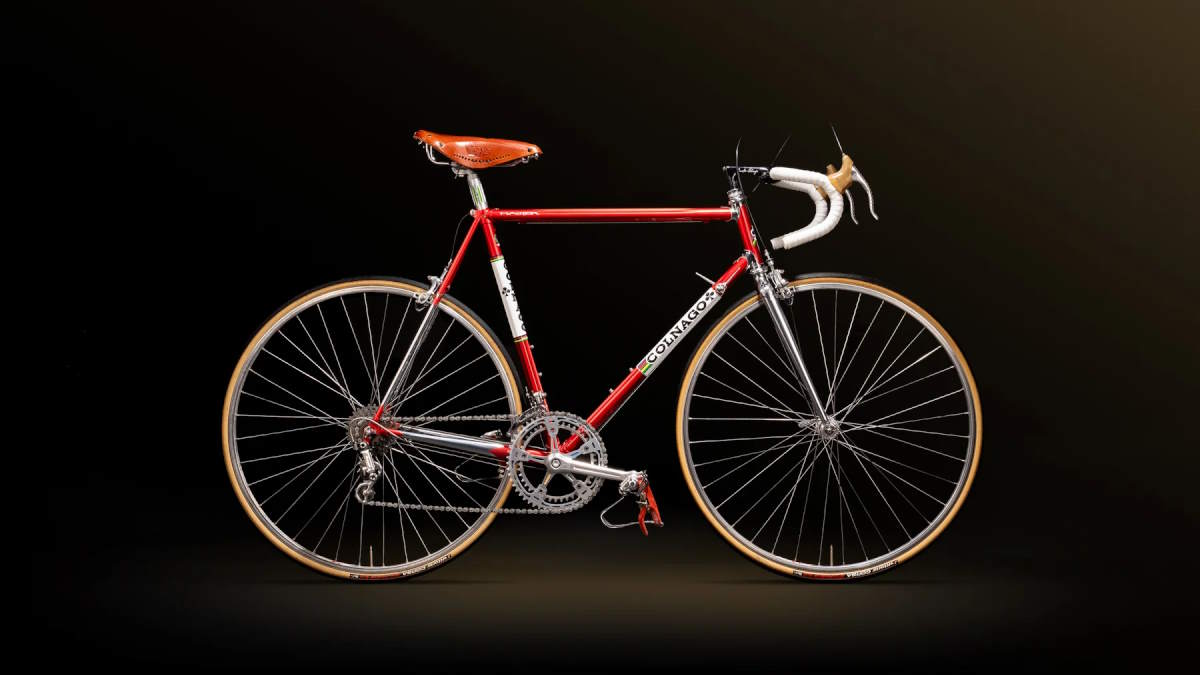
The Colnago Master is one of those rare bicycles that is simultaneously a genuine historical racing machine, a piece of Italian industrial design, and a bicycle you can still buy new more than four decades after it was created. It is not merely a modern steel bike made to look retro: the current Master continues the frame family Colnago introduced at the beginning of the 1980s, still using its defining star-profile tubes, lugged construction, and steel Precisa fork.
And there is quite a lot more to its history than the usual story of “beautiful Italian steel bike with funny-shaped tubes.”
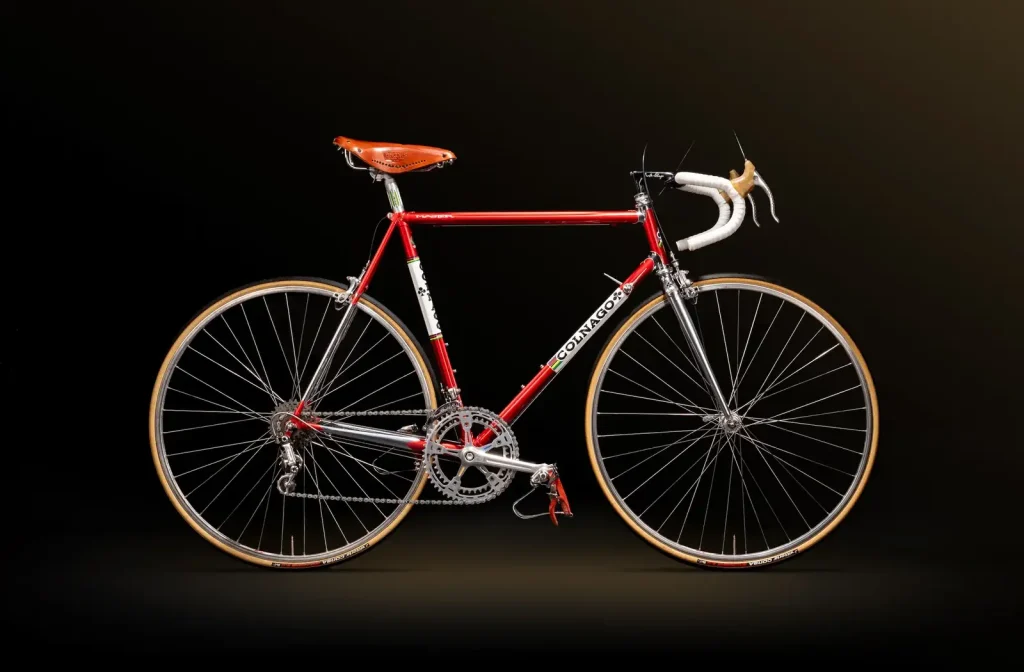
Where the iconic “Master” fits into Colnago history
To understand Colnago Master, it helps to start a little earlier.
Ernesto Colnago founded his own business in Cambiago in 1954, after working for Gloria and establishing a reputation both as a mechanic and frame builder. By the 1960s and 1970s, he had become deeply involved with professional racing, working with riders including Gianni Motta and Eddy Merckx.
One especially important predecessor to the Master was the Colnago Mexico. The name referred to Eddy Merckx’s extraordinary 1972 Hour Record in Mexico City. The Master was developed at the end of 1982 as the next step in Colnago’s steel racing frames, and regular production is generally dated to 1983. Colnago’s own historical archive lists the Master as a 1983 model, while a separate Colnago historical document says it was “born at the end of 1982.” Both statements can therefore be true: development/prototypes in late 1982, commercial production in 1983.
There is an important detail here that is frequently confused:
Giuseppe “Beppe” Saronni did not win the 1982 UCI World Championship on a Colnago Master. His famous Goodwood victory was on an earlier Colnago, generally identified as a Mexico. The Master was just emerging. But Saronni then rode the Master during its first great season and won the 1983 Giro d’Italia, making him one of the riders most strongly associated with the model. The deep metallic red, consequently known as “Saronni Red,” became one of the defining Colnago colors.
Colnago Master Timeline
So the neat chronology is:
- 1972: Eddy Merckx Hour Record → Mexico becomes a major Colnago name
- 1982: Saronni wins Worlds on pre-Master Colnago riding a Mexico; Master development occurs late in the year
- 1983: Master enters production; Saronni wins Giro
- Late 1980s: Master Più and straight Precisa fork
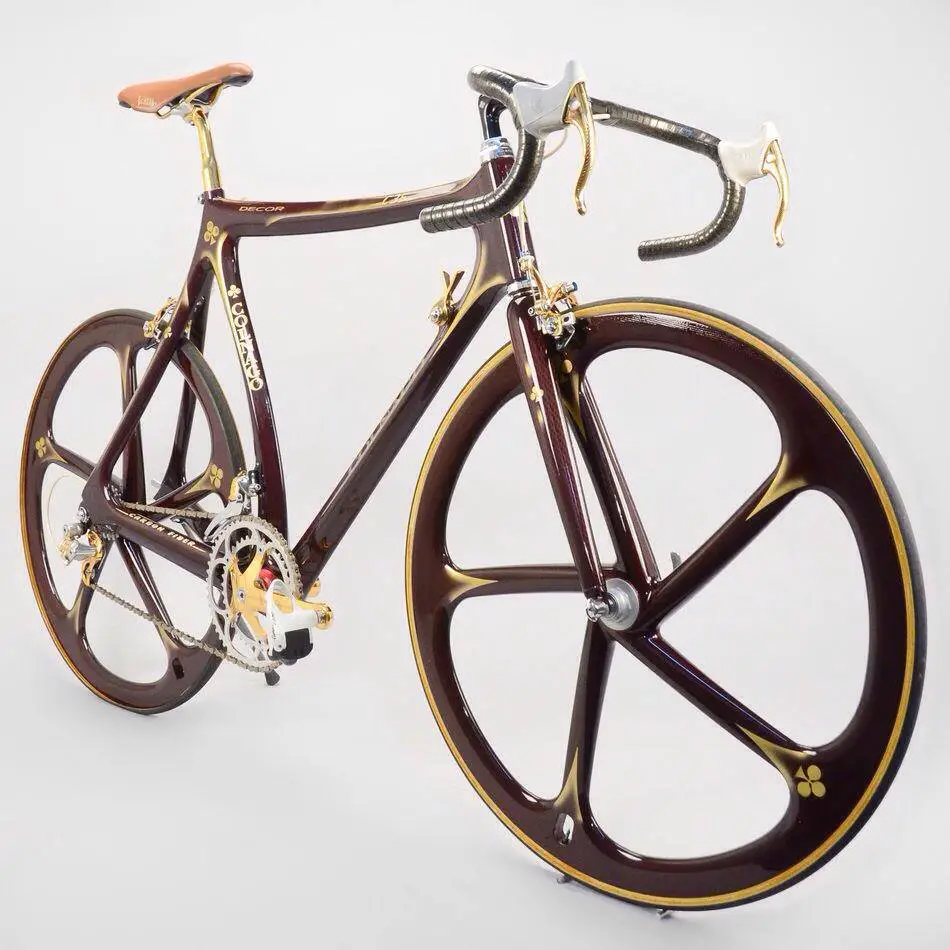
- Early 1990s: Master Olympic; Art Decor era develops
- 1994: Master Light
- Late 1990s / ~2000: Master X-Light
- 2000s: Experiments including carbon rear ends
- 2009: 55th-anniversary Master (Colnago’s 55th year)
- 2013: 30th-anniversary Master
- 2026: Master is still in Colnago’s catalogue. Colnago itself calls it its archetypal/classic steel frame and continues to build it in Italy.
The really important innovation: the star-shaped tubes
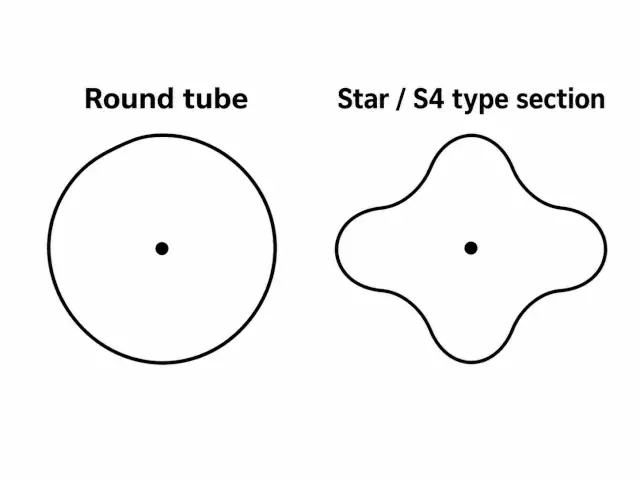
If you had to identify a Colnago Master from ten metres away, the giveaway would be the tubing: Traditional steel racing frames of the period mostly used round tubes. The Master instead used tubes with four longitudinal indentations/ribs, producing the famous approximately four-lobed or star-shaped cross-section.
Colnago today calls this the S4 Profile, and its star shape is particularly obvious when looking along the down tube rather than looking at it from the side. And it wasn’t simply decorative.
Why shape a steel tube like that?
Here’s why Colnago Master has star-shaped tubes.
It is an interesting engineering problem. For a tube under bending, stiffness depends substantially on its second moment of area. For torsion, the geometry of the cross-section similarly matters. You can therefore alter the stiffness characteristics of a tube without simply making the walls much thicker.
By deforming the circular tube into the Master profile, material can be positioned farther from the neutral axis in particular directions. Colnago’s intention was to increase frame stiffness, especially in response to powerful professional riders who complained about frame flex.
Colnago describes the four ribs as making the tube stiffer and eventually allowing it to become lighter.
There is an important bit of materials science here.
A stronger steel alloy does not inherently have a dramatically higher Young’s modulus (see the notes below this post) than an ordinary steel alloy. Most steels sit around 200 GPa (Gigapascal). What stronger steel permits is thinner tubing without yielding or buckling, while tube diameter, shape, and wall thickness determine much of the actual frame stiffness.
So the clever part of the Master wasn’t simply:
“better steel = stiffer bicycle.”
It was:
higher-performance steel + thin walls + carefully controlled wall thickness + non-circular tube geometry.
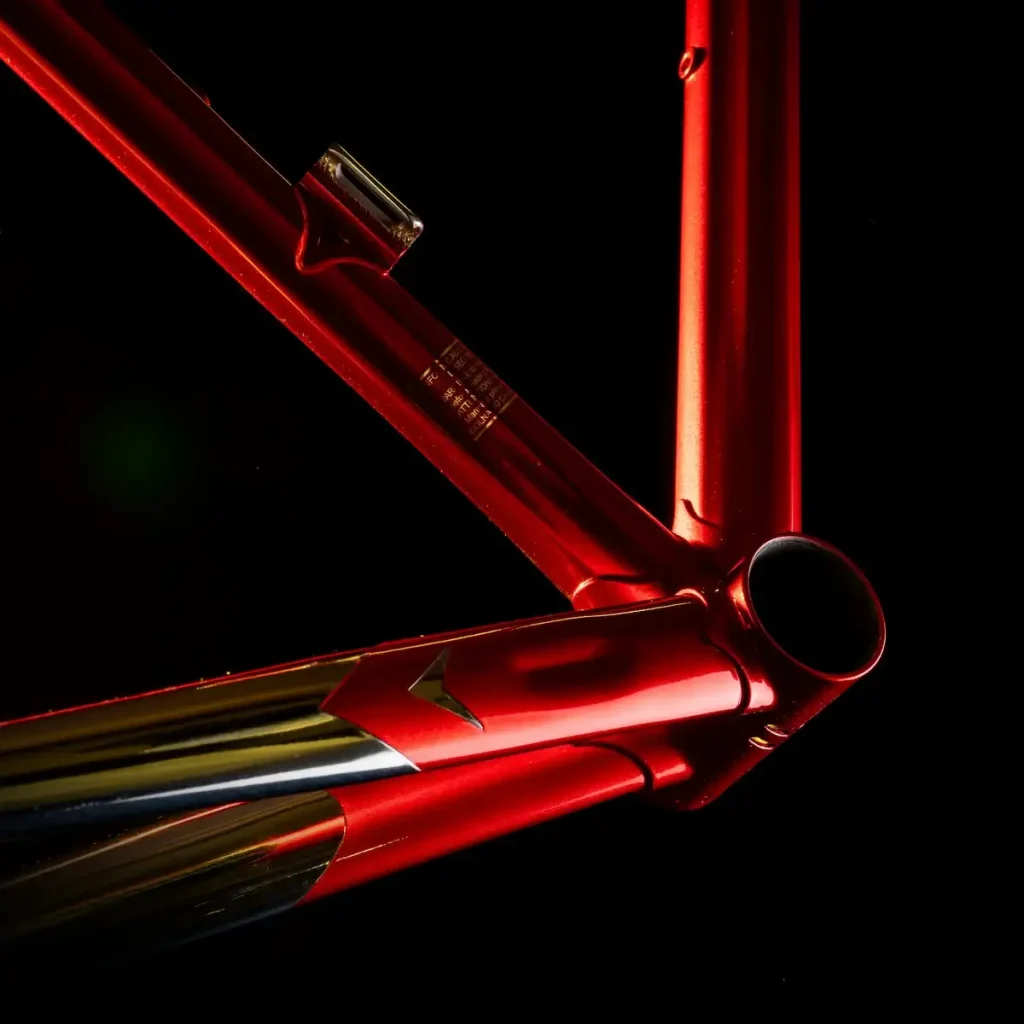
Image source: Colnago’s official website.
“Gilco” doesn’t quite mean what many people think it means
This is one of my favourite lesser-known Master facts.
You’ll often see Master tubing described as Columbus Gilco, and it is easy to assume “Gilco” was simply another Columbus tubing series like SL, SLX or EL. The real history is more complicated.
Gilberto Colombo was the son of Angelo Luigi Colombo, founder of the company from which Columbus tubing developed. Gilberto’s brother Antonio Colombo became closely associated with Columbus, while Gilberto established his own highly specialised tubing operation, Trafiltubi, and worked under the Gilco/Gilco Design name.
Trafiltubi’s own history says explicitly that, at Ernesto Colnago’s request, Gilberto created the S/4 star profile that became the Master
So:
Gilco ≈ Gilberto Colombo, not simply “Columbus tubing.”
And Gilberto Colombo wasn’t merely a bicycle-tube specialist. He worked with specialised tubing, industrial design, automobiles, boats, and architecture. His company developed very sophisticated cold-drawing methods.
The T15 drawing technology
Gilberto Colombo developed an oleodynamic/hydraulic drawing system, generally referred to as the T15, capable of producing tubing with controlled profiles and different wall thicknesses along the tube. That matters because bicycle tubing ideally isn’t the same thickness everywhere.
Near joints-bottom bracket, head tube, seat cluster-you want additional material because stresses are concentrated there.
In the middle of the tube, you can reduce wall thickness and save weight.
This general idea is what cyclists know as butted tubing, but Gilberto’s technology allowed highly sophisticated combinations of profile and thickness.
Trafiltubi credits this technology and the special S4 profile with the Master project.
Over the decades, alloys and suppliers changed, which is why you may encounter confusing references to Gilco S4, Columbus, Tange, Dedacciai/Deda, and DT15V when researching different Masters. They are not necessarily contradictions. You’re looking at a bicycle family that has been in production for more than 40 years.
The first Colnago Master was actually quite different from today’s Master

Although the distinctive star-shaped tubing remained the defining feature of the Colnago Master, the earliest frames differed from later versions in several important details.
The original Master used a curved steel fork, which was still the conventional choice for high-end road bikes in the early 1980s. It also had an externally routed rear-brake cable, running along the top tube rather than through it. Colnago’s own historical material specifically identifies these features as characteristics of the early Master
That changed with the later Master Più. One of its most visible updates was the relocation of the rear-brake cable inside the top tube, giving the frame a cleaner appearance. This can be a useful clue when identifying vintage Masters: early examples generally have an external top-tube brake cable, while the Master Più is associated with internal routing.
As with many older Colnagos, however, these distinctions should not be treated as absolute. Transitional frames, special-order builds, team bikes, replacement forks, and later modifications can blur the boundaries between model generations.
The arrival of the Precisa fork
One of the most important visual changes in Colnago Master’s evolution was the introduction of the Colnago Precisa, the straight-bladed steel fork that would eventually become almost as recognisable as the frame’s star-shaped tubing.
The Precisa appeared toward the end of the 1980s. According to Colnago, its development was connected with the company’s technical collaboration with Ferrari. At the time, the design was strikingly unconventional. High-end Italian road bikes were strongly associated with gracefully curved fork blades, so the appearance of two nearly straight steel blades challenged a long-established visual and engineering tradition.

Image source: Colnago’s official website.
Today, the Precisa looks completely natural on a Colnago Master, but in the late 1980s it would have appeared radical. Its sharply defined lines also complemented the more technical appearance of the Master’s shaped tubing, helping give the bike a very different character from the softer, more traditional look of earlier steel racing frames.
Colnago has long argued that the Precisa offered advantages in handling, control, and vibration behaviour, and the company continues to describe it in those terms. Colnago Master These claims should be interpreted with some care, however. A fork’s stiffness and compliance depend on much more than whether its blades are straight or curved. Blade cross-section, wall thickness, taper, rake, material distribution, and overall construction all influence how a fork behaves.
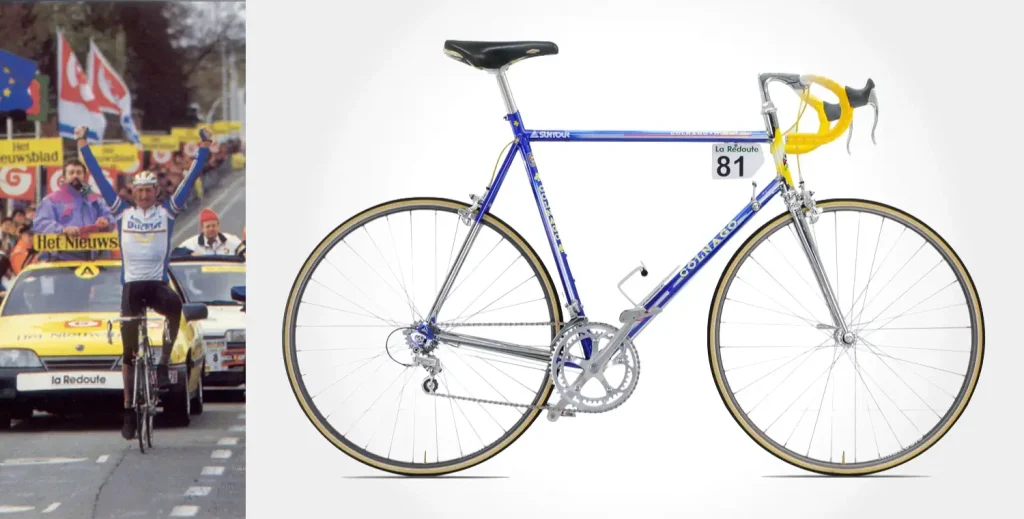
What is beyond doubt is that the Precisa proved itself in professional racing and became closely associated with the Master. One notable example is Edwig van Hooydonck’s victory in the 1991 Tour of Flanders, achieved on a Colnago Master fitted with a Precisa fork.
Notes
1. Young’s Modulus
Young’s modulus is basically a measure of how stiff the steel itself is – how much it elastically stretches or compresses when you apply a force.
In simple terms:
- high Young’s modulus = material is harder to deform elastically
- low Young’s modulus = material deforms more easily
The definition is:
where stress is force per unit area, and strain is the fractional change in length.
For most steels, Young’s modulus is around 200 GPa. The important point for the Colnago Master discussion is that a very strong, expensive steel alloy does not necessarily have a much higher Young’s modulus than ordinary steel.
For example, roughly speaking:
- ordinary mild steel: ~200 GPa (Gigapascal)
- high-strength chromoly bicycle steel: ~200-210 GPa
- stainless bicycle steels: also around ~190-200+ GPa
So if you made two tubes with exactly the same dimensions, one from ordinary steel and one from a much stronger high-end bicycle steel, their elastic stiffness would be surprisingly similar.
The stronger alloy’s advantage is something different: it can tolerate much higher stress before permanently bending or failing.
That distinction is crucial.
Imagine two identical steel tubes. You push sideways on both with moderate force. Both flex by almost the same amount because their Young’s modulus is similar.
But if you keep increasing the force, the cheaper/less-strong steel may eventually yield-meaning it no longer springs completely back to its original shape. The stronger steel can withstand a much higher stress before that happens.
This is why high-strength bicycle steel is useful. A framebuilder can use thinner tube walls and therefore reduce weight while still maintaining adequate strength.
And this is where tube shape becomes important on the Colnago Master.
The stiffness of a bicycle tube in bending is approximately related to:
where:
- E = Young’s modulus of the material
- I = second moment of area, determined by the shape and dimensions of the tube
For steel, E doesn’t change very much from one alloy to another.
But I can change enormously if you change:
- tube diameter
- wall thickness
- cross-sectional shape
- tube profile
That is why Colnago’s star-shaped Master tubing is interesting. They couldn’t dramatically increase E, because steel is steel in that respect. But they could manipulate I by changing the tube’s geometry.
A simple bicycle example. Suppose you have:
- Tube A: small round steel tube
- Tube B: larger or specially shaped steel tube
Both may use steel with almost the same Young’s modulus. But Tube B can be much stiffer because its material is positioned farther away from the centre of the tube.
That’s basically why modern bicycles have enormous down tubes. It’s not necessarily because the carbon or aluminium itself has magically become “stiffer”; the geometry of the structure is doing a lot of the work.
Why does distance from the center matter so much?
In structural mechanics, the second moment of area contains a squared distance term:
The important part is y2, which means a small amount of material placed farther away from the neutral axis can contribute much more to bending stiffness than the same material placed close to the center.
For example, material:
- 1 mm from the neutral axis contributes proportionally to 12 = 1
- 2 mm away contributes 22 = 4
- 3 mm away contributes 32 = 9
… and so on. So designers can often make a structure much stiffer simply by changing where the material is, rather than adding lots more material.
That is the same basic reason why an I-beam is so efficient: most of its material is concentrated far from the neutral axis. An I-beam is not stiff because its steel has a special Young’s modulus. It is stiff because its shape places material where it contributes most.
Colnago Master’s star tubing uses the same broad structural principle, though obviously in a very different form.
And torsional stiffness also changes
A bicycle frame is not subjected only to simple bending. When you pedal hard, sprint, or corner, the frame also experiences torsion.
For torsion, the corresponding simplified relationship is:
where:
- G = shear modulus of the material
- J = torsional constant / polar-type geometric property
Again, G is mainly determined by the material, while J depends strongly on the cross-sectional geometry.
So by changing the tube from circular to ribbed/star-shaped, Colnago could change both:
- bending behaviour
- torsional behaviour
without needing fundamentally different steel.
In summary, Colnago Master’s S4 tubing did not make the steel itself stiffer. Steel alloys have broadly similar Young’s moduli. Instead, Colnago increased the tubes’ structural stiffness by reshaping their cross-section. The four longitudinal ribs placed more material farther from the tube’s neutral axis, increasing the second moment of area and therefore resistance to bending. This allowed thinner, lighter tubing to retain high stiffness.
Sources
- Colnago Master on the official Colnago website
- Colnago’s Past Models
- Trafiltubi History on the Trafiltubi official website

- Colnago Master - September 24, 2026
- Tour de France Winner Groupsets [Year by Year, from 1937 to 2026] - July 26, 2026
- UCI Elite Men Road Race World Champions: The Complete List [1927-2025] - September 28, 2025
